
Alternative therapies may help curb meth cravings – Part Two
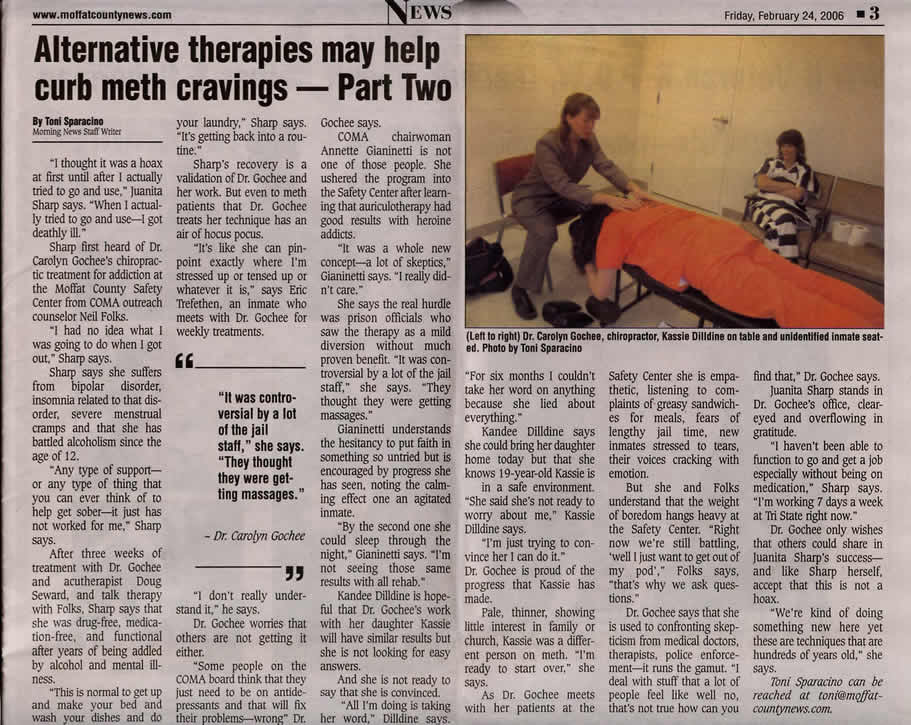
A look at how auriculotherapy and supportive care are aiding recovery at the Moffat County Safety Center
Author: Toni Sparacino, Morning News Staff Writer
Date: Friday, February 24, 2006
Introduction
In Part Two of our series on alternative therapies for meth addiction, we revisit how a washtub of skepticism meets a holistic approach at the Moffat County Safety Center. Dr. Carolyn Gochee’s acupuncture-inspired auriculotherapy (ear acupuncture) and integrated therapy, combined with counseling, are shaping a path to sobriety for some patients. Here, patient stories and professional perspectives illuminate both the promise and the challenges of this approach.
Personal journeys and initial doubts
- Juanita Sharp’s turning point
- “I thought it was a hoax at first until after I actually tried to go and use,” Sharp recalls. “When I actually tried to go and use—I got deathly ill.”
- Sharp first heard about Dr. Gochee’s chiropractic treatment for addiction at the Safety Center from COMA outreach counselor Neil Folks.
- Facing bipolar disorder, insomnia, severe menstrual cramps, and a long battle with alcoholism since age 12, Sharp describes how previous supports “just have not worked for me.”
- After three weeks of treatment with Dr. Gochee and acutherapist Doug Seward, plus talk therapy with Folks, Sharp reports she was drug-free, medication-free, and functioning again. “This is normal to get up and make your bed and wash your dishes and do your laundry. It’s getting back into a routine.”
- Sharp’s progress brings renewed hope for a life in sobriety and steadier daily rhythms.
A contrasting view from the jail setting
- Eric Trefethen’s experience
- An inmate who attends weekly treatments with Dr. Gochee says, “It’s like she can pinpoint exactly where I’m stressed up or tensed up or whatever it is.”
- He candidly adds, “I don’t really understand it,” reflecting the mixture of curiosity and skepticism that persists in some quarters of the jail staff.
- The broader skepticism
- Dr. Gochee acknowledges that some people, including members of the COMA board, favor antidepression medications as a fix, which she disputes: “Some people on the COMA board think that they just need to be on antidepressants and that will fix their problems—wrong.”
Support and hurdles from leadership
- Annette Gianinetti’s stance
- COMA chairwoman Gianinetti moved the program into the Safety Center after learning auriculotherapy had shown good results with heroin addicts.
- “It was a whole new concept—a lot of skeptics,” she says, noting that prison officials initially viewed the therapy as a mild diversion without proven benefit.
- Yet she’s seen progress: “By the second one she could sleep through the night,” she says of an agitated inmate. While not universal, the calming effect is encouraging.
- Kandee Dilldine’s cautious optimism
- Dilldine hopes similar progress for her daughter Kassie, but she’s not ready to claim certainty. “All I’m doing is taking her word,” she says, reflecting a parent’s careful optimism.
- Kassie, pale and thinner on meth, insists she’s ready to start over: “I’m ready to start over.”
Dr. Gochee’s perspective and patient-centered care
- The role of empathy and listening
- As Dr. Gochee sees patients, she remains aware of the day-to-day realities inside the Safety Center: complaints about greasy sandwiches, fears of lengthy jail time, and inmates who are stressed to tears.
- She emphasizes that the weight of boredom is heavy in the facility, and that counselors like Folks ask the right questions to keep residents engaged in treatment.
- Navigating skepticism in medicine and enforcement
- Dr. Gochee notes she’s used to confronting skepticism from medical doctors, therapists, and police—“it runs the gamut.” Her approach is to listen, validate concerns, and keep asking questions.
Juanita Sharp’s gratitude and current life
- The breakthrough
- Standing in Dr. Gochee’s office, Sharp is clear-eyed and grateful: “I haven’t been able to function to go and get a job, especially without being on medication. I’m working 7 days a week at the State right now.”
- A wish for wider acceptance
- Dr. Gochee wishes others could share in Sharp’s success and accept that these aren’t hoaxes—“we’re kind of doing something new here yet these are techniques that are hundreds of years old.”
Closing thoughts
- The potential of a multi-faceted approach
- The combination of auriculotherapy, acutherapy, talk therapy, and supportive counseling offers a hopeful path for some meth users seeking sobriety.
- As with any emerging treatment, experiences vary, skepticism remains, and ongoing evaluation is essential.
About the author
- Toni Sparacino is a staff writer for the Morning News. You can reach her at toni@moffat-countynews.com.