
Alternative therapies may suppress meth cravings
By Toni Sparacino
Morning News Staff Writer
Kassie Dilldine was taking multi-vitamins for two days before the Moffat County Safety Center stopped giving them to her. Dr. Carolyn Gochee explains that methamphetamines strip the body of nutrients and that vitamins help restore energy and suppress cravings. “She’s not allowed to have them again because I’m not an MD,” Gochee says. The vitamins cost about $30 per month — more than most inmates can afford. Dilldine is lucky, Dr. Gochee says, because she has a good family support system and because she is young. Dilldine is 19, and her troubles with meth only began as recently as July. “She didn’t use for ten years like some of the other ones that we have,” Gochee says.
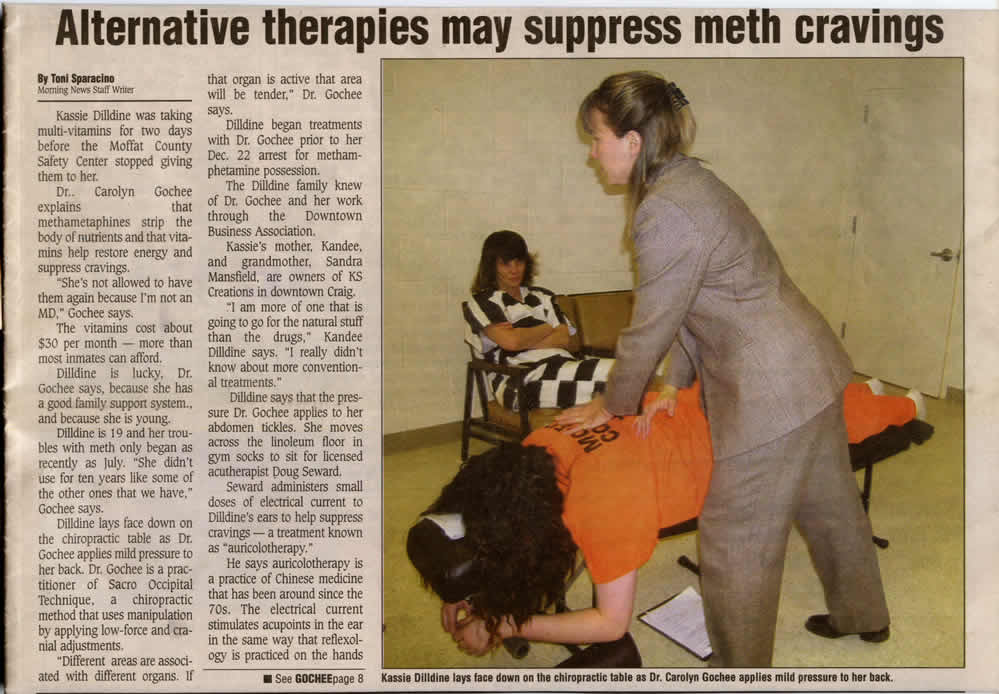
Dilldine lays face down on the chiropractic table as Dr. Gochee applies mild pressure to her back. Dr. Gochee is a practitioner of Sacro Occipital Technique, a chiropractic method that uses manipulation by applying low-force and cranial adjustments. “Different areas are associated with different organs. If that organ is active, that area will be tender,” Dr. Gochee says. Dilldine began treatments with Dr. Gochee prior to her Dec. 22 arrest for methamphetamine possession. The Dilldine family knew of Dr. Gochee and her work through the Downtown Business Association. Kassie’s mother, Kandee, and grandmother, Sandra Mansfield, are owners of KS Creations in downtown Craig. “I am more of one that is going to go for the natural stuff than the drugs,” Kandee Dilldine says. “I really didn’t know about more conventional treatments.”
Dilldine says that the pressure Dr. Gochee applies to her abdomen tickles. She moves across the linoleum floor in gym socks to sit for licensed acutherapist Doug Seward. Seward administers small doses of electrical current to Dilldine’s ears to help suppress cravings — a treatment known as “auriculotherapy.” He says auriculotherapy is a practice of Chinese medicine that has been around since the 70s. The electrical current stimulates acupoints in the ear in the same way that reflexology is practiced on the hands.
Photo Description:
Kassie Dilldine lays face down on the chiropractic table as Dr. Carolyn Gochee applies mild pressure to her back.
8 Sunday, February 19, 2006, 2005
NEWS
Moffat County Morning News
Miracle or method?
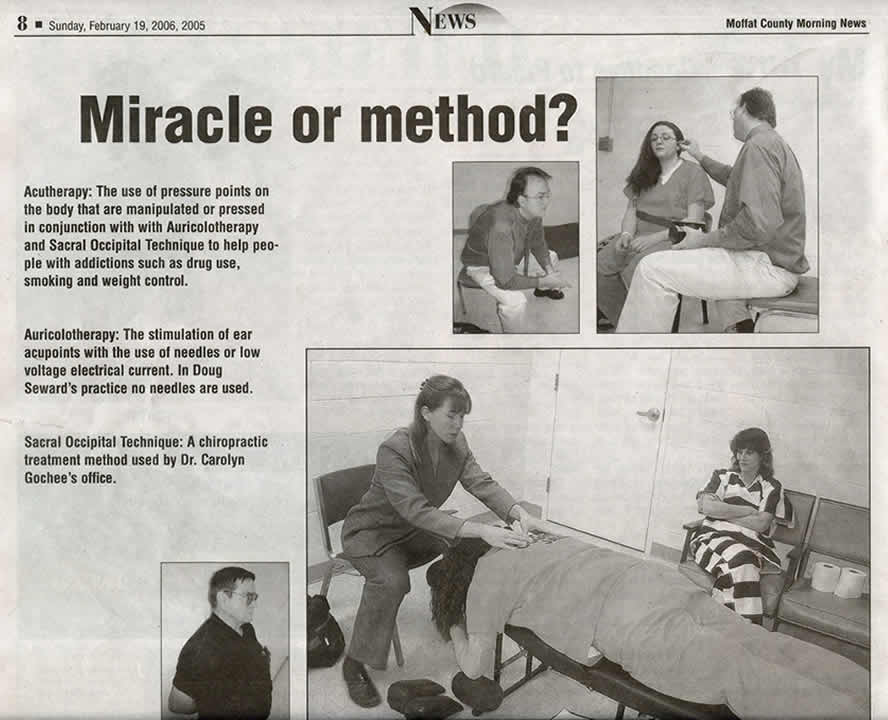
Acutherapy: The use of pressure points on the body that are manipulated or pressed in conjunction with Auricolotherapy and Sacral Occipital Technique to help people with addictions such as drug use, smoking, and weight control.
Auriculotherapy: The stimulation of ear acupoints with the use of needles or low voltage electrical current. In Doug Seward’s practice no needles are used.
Sacral Occipital Technique: A chiropractic treatment method used by Dr. Carolyn Gochee’s office.
INMATE 2000
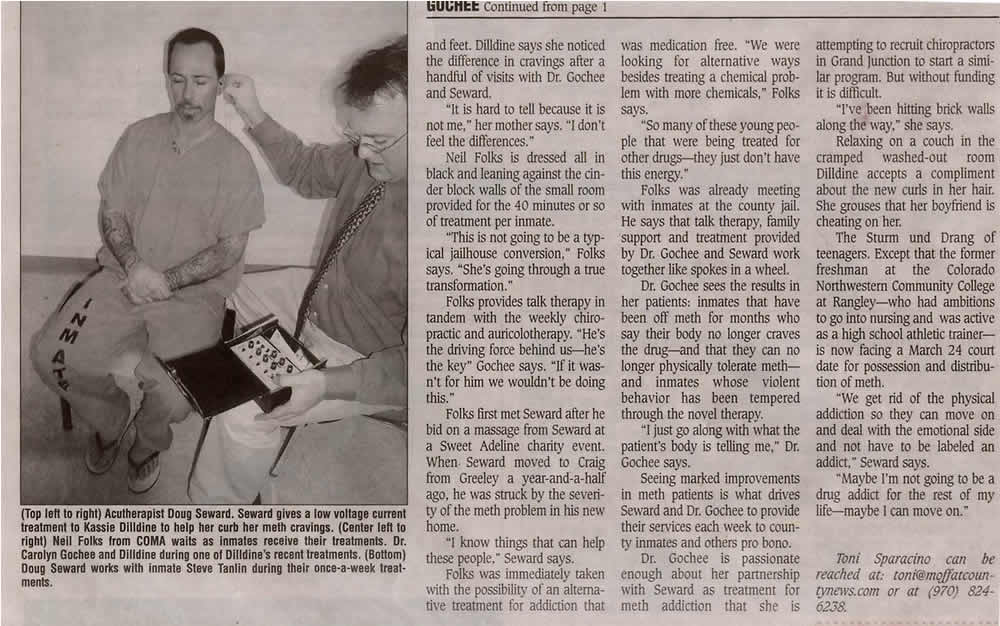
(Top left to right) Acutherapist Doug Seward. Seward gives a low voltage current treatment to Kassie Dilldine to help her curb her meth cravings. (Center left to right) Neil Folks from COMA waits as inmates receive their treatments. Dr. Carolyn Gochee and Dilldine during one of Dilldine’s recent treatments. (Bottom) Doug Seward works with inmate Steve Tanlin during their once-a-week treatments.
GOCHEE Continued from page 1
Dilldine says she noticed the difference in cravings after a handful of visits with Dr. Gochee and Seward.
“It is hard to tell because it is not me,” her mother says. “I don’t feel the differences.”
Neil Folks is dressed all in black and leaning against the cinder block walls of the small room provided for the 40 minutes or so of treatment per inmate.
“This is not going to be a typical jailhouse conversion,” Folks says. “She’s going through a true transformation.”
Folks provides talk therapy in tandem with the weekly chiropractic and auriculotherapy. “He’s the driving force behind us—he’s the key,” Gochee says. “If it weren’t for him we wouldn’t be doing this.”
Folks first met Seward after he bid on a massage from Seward at a Sweet Adeline charity event.
When Seward moved to Craig from Greeley a year-and-a-half ago, he was struck by the severity of the meth problem in his new home.
“I know things that can help these people,” Seward says.
“we were medication free.” “We were looking for alternative ways besides treating a chemical problem with more chemicals,” Folks says.
Folks was immediately taken with the possibility of an alternative treatment for addiction that—so many of these young people that were being treated for other drugs—they just don’t have this energy.
Folks was already meeting with inmates at the county jail.
He says that talk therapy, family support, and treatment provided by Dr. Gochee and Seward work together like spokes in a wheel.
Dr. Gochee sees the results in her patients: inmates that have been off meth for months who say their body no longer craves the drug—and that they can no longer physically tolerate meth, and inmates whose violent behavior has been tempered through the novel therapy.
“I just go along with what the patient’s body is telling me,” Dr. Gochee says.
Seeing marked improvements in meth patients is what drives Seward and Dr. Gochee to provide their services each week to county inmates and others pro bono.
Dr. Gochee is passionate enough about her partnership with Seward as treatment for meth addiction that she is attempting to recruit chiropractors in Grand Junction to start a similar program. But without funding it is difficult.
“I’ve been hitting brick walls along the way,” she says.
room
Relaxing on a couch in the cramped washed-out room Dilldine accepts a compliment about the new curls in her hair. She grouses that her boyfriend is cheating on her.
The Sturm und Drang of teenagers. Except that the former freshman at the Colorado Northwestern Community College at Rangley—who had ambitions to go into nursing and was active as a high school athletic trainer—is now facing a March 24 court date for possession and distribution of meth.
“We get rid of the physical addiction so they can move on and deal with the emotional side and not have to be labeled an addict,” Seward says.
“Maybe I’m not going to be a drug addict for the rest of my life—maybe I can move on.”
Toni Sparacino can be reached at toni@moffatcountynews.com or at (970) 824-6238.